Reading time: 16 min | Last updated: June 2026 | Author: Pets Sparkle Team
Table of Contents
- What Are the Different Types of Dog Anxiety?
- How Do You Recognize Anxiety in a Dog?
- What Actually Causes Dog Anxiety?
- What Are the Proven Ways to Reduce Dog Anxiety?
- Why Is Mental Enrichment the Most Underrated Fix?
- What Does a Daily Routine for an Anxious Dog Look Like?
- Which Products Actually Help Anxious Dogs?
- When Should You See a Vet About Anxiety?
- How Long Does It Take to Calm an Anxious Dog?
- Frequently Asked Questions
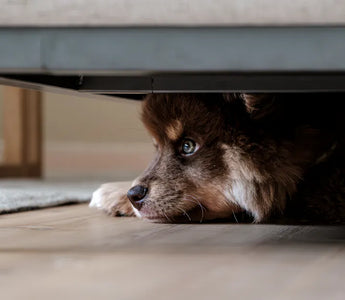
Your dog hides under the sofa during thunderstorms. They howl the moment you close the front door. They redecorated your couch the last time you stepped out for groceries.
You're not dealing with a "bad" dog. You're dealing with an anxious one — and the difference matters because the fix for anxiety isn't discipline. It's structure, enrichment, and (sometimes) veterinary support.
Dog anxiety is one of the most common — and most misunderstood — behavioral issues in pet ownership. A 2020 study in Scientific Reports found that 72.5% of dogs exhibit anxiety-related behavior, and for roughly 25%, it's a chronic, daily struggle. The hard part: anxious behavior looks exactly like "bad behavior" — destructive chewing, barking, aggression, house accidents — which leads owners to reach for correction when the dog actually needs support.
This guide covers every type of dog anxiety, how to recognize it before it escalates, what the evidence-backed solutions actually are, and the specific routines and products that help anxious dogs settle into genuinely comfortable lives.
What Are the Different Types of Dog Anxiety?
There are five primary types of dog anxiety: separation anxiety (triggered by being alone), noise anxiety (specific sounds like thunderstorms or fireworks), social anxiety (fear of unfamiliar people or animals), generalized anxiety disorder (chronic, no single trigger), and travel anxiety (fear in vehicles). Most anxious dogs have one dominant type and one secondary type — the treatments overlap heavily.
Understanding which type your dog has shapes everything that comes next. A noise-anxious dog needs predictive desensitization and a quiet retreat space. A separation-anxious dog needs gradual departure conditioning. Social anxiety needs slow, paired-positive exposure. Treating all anxiety the same way is one of the most common mistakes — and it's why so many "general training tips" don't move the needle for specific anxious dogs.
Separation Anxiety
The most common type, affecting roughly 14–20% of dogs. Triggered by absence of the attached person, often a single primary owner. Signs: destructive behavior at exits (doors, windows), howling or whining the entire time you're gone, house accidents in dogs that are otherwise reliably trained, and extreme greeting behavior when you return — frantic jumping, urination, vocalization. The intensity doesn't fade with absence duration. A dog with true separation anxiety distresses just as much during a 20-minute absence as a 4-hour one.
Noise Anxiety
Specific sound triggers — thunderstorms, fireworks, construction noise, vacuum cleaners. Signs: trembling, hiding (often in bathrooms or closets), panting, attempting to escape (windows, doors), loss of house training during the trigger. Some dogs develop a window of distress that starts before the noise (thunder-anxious dogs sense the air pressure change) and lingers for hours after.
Social Anxiety
Fear of unfamiliar people or animals. Common in dogs with limited socialization windows as puppies (the critical period is 3–14 weeks). Signs: growling, cowering, hiding behind owners, backing away from approaches, fear-based snapping when cornered. This often gets misread as "aggression" — but the dog is asking to be left alone, not threatening.
Generalized Anxiety Disorder
Chronic, low-grade anxiety with no single identifiable trigger. Often has a genetic component (some breeds and bloodlines predispose toward it). Signs: persistent jumpiness, difficulty settling even in quiet environments, constant hypervigilance, sleep disruption, and a baseline elevated heart rate. These dogs are anxious as a default state.
Travel Anxiety
Fear response specifically in vehicles. Sometimes confused with motion sickness — but a motion-sick dog vomits, while a travel-anxious dog drools, panics, and refuses to enter the car. Many travel-anxious dogs only experience symptoms during specific drives (vet visits, boarding) because they've associated the car with the destination, not the journey.
How Do You Recognize Anxiety in a Dog?
Anxious dogs show physical and behavioral signals long before they reach crisis. Early signs include yawning when not tired, repeated lip-licking, turning their head away from interactions, "whale eye" (whites of eyes visible), and a tucked tail during normal activities. Escalation signs include panting without heat, refusing favorite food, and excessive sniffing to avoid contact. The earlier you spot these, the earlier you can intervene.
The biggest skill for living with an anxious dog is reading their body language before they hit visible distress. By the time most owners notice anxiety, their dog has been trying to communicate it for 30 minutes already. Catching the early signals lets you change the situation before the dog escalates — which makes every future trigger easier, not harder, because the dog hasn't reinforced the panic loop.
Early signals (easy to miss):
- Yawning when not tired
- Repeated lip or nose licking
- Turning head away during interaction or eye contact
- "Whale eye" — whites of the eyes visible at the corners
- Tucked tail during apparently normal activities
- Subtle "freeze" — the dog stops moving and goes very still
Escalating signals:
- Panting without heat or recent exercise
- Sudden "shake off" as if shaking off water (when not wet)
- Refusing food they normally love
- Excessive ground sniffing as a way to avoid interaction
- Pacing, repeated bed-shifting
- Inability to settle even when tired
High-stress / crisis signals:
- Trembling or shaking
- Shutdown behavior (the dog goes limp, stops responding)
- Fear-based aggression progressing through the bite warning ladder: growl → snap (air bite) → contact bite
According to the ASPCA, learning to read early stress signals is the most important skill for managing anxious dogs. It lets you intervene before the dog reaches threshold — and over time, that prevents the panic loop from deepening. Every successful pre-crisis intervention is a small training session for the dog: I felt overwhelmed, my human noticed, the situation changed, I'm okay now.
What Actually Causes Dog Anxiety?
Dog anxiety has four main causes that often combine: genetics (some breeds and bloodlines predispose toward it), undersocialization in the critical 3–14 week puppy window, trauma or major change (rehoming, owner loss, accident), and chronic understimulation (mental and physical). Most anxious dogs you'll meet have at least two of these contributing factors.
Genetics and Breed Predisposition
Some breeds and individual bloodlines simply produce more anxious dogs. Working herding breeds (Border Collies, Australian Shepherds) and high-drive sporting breeds tend toward higher baseline arousal that can tip into anxiety without proper outlets. Sighthounds, on the other hand, can be remarkably anxious in busy environments because they've been bred for visual sensitivity.
The Socialization Window
Puppies have a critical socialization period from roughly 3–14 weeks of age. Dogs who don't experience a wide variety of people, animals, surfaces, sounds, and environments during this window often develop anxious responses to novelty later in life. Pandemic-era puppies were a textbook example — many didn't meet enough strangers during their socialization window and grew into adults with social anxiety.
Trauma and Major Life Changes
Rehoming, the loss of a family member, a car accident, a dog attack, or a prolonged kennel stay can all create anxiety in previously confident dogs. The single traumatic events can reshape a dog's stress response for years — particularly if the trauma occurred during a fear period (around 8–11 weeks and again around 6–14 months).
Chronic Understimulation
This is the most fixable cause. A dog with too much daily energy and too few outlets will redirect that energy into anxious patterns. The fix is daily physical AND mental enrichment — most owners do enough of one but not the other.
What Are the Proven Ways to Reduce Dog Anxiety?
Six interventions consistently work: (1) consistent daily routine, (2) 30–60 minutes of daily physical exercise, (3) daily mental enrichment via puzzle feeders and training, (4) gradual desensitization to specific triggers, (5) a voluntary safe space, and (6) veterinary support for moderate-to-severe cases. The combination of physical exercise + mental enrichment is consistently more effective than either alone.
1. Routine and Predictability
Anxious dogs thrive on predictability. Consistent feeding times, walk times, and departure rituals reduce the uncertainty that fuels anxiety. The AKC recommends establishing a calm, consistent departure routine — no dramatic goodbyes, no frantic returns. The boring departure is the kind one.
2. Daily Physical Exercise
A well-exercised dog has measurably less nervous energy to redirect into anxious behavior. Minimum 30–60 minutes of active exercise per day for most breeds, more for high-drive working breeds. Exercise alone won't cure anxiety — but inadequate exercise will worsen it.
3. Mental Enrichment — The Most Underused Tool
This is where most owners fall short. Physical exercise tires the body. Mental enrichment tires the brain — and an anxious brain that's genuinely engaged cannot simultaneously maintain hypervigilance. It's a state-incompatibility, the same reason you can't be deeply absorbed in a puzzle and panicked at the same time.
4. Desensitization and Counter-Conditioning
Gradual, deliberate exposure to anxiety triggers at low intensity, paired with positive experiences. For separation anxiety: start by leaving the room for 10 seconds, return before any distress, gradually increase duration over weeks. For noise anxiety: low-volume recorded thunder paired with high-value treats. The principle: never expose your dog above their threshold of distress. Cross threshold and you reinforce the panic, not the calm.
5. Safe Space Creation
A covered crate, a corner bed, or a quiet room — wherever your dog naturally seeks refuge. The space must be chosen by your dog, not imposed. Never use this space for punishment. It's a sanctuary the dog enters voluntarily; the moment you start using it as time-out, it stops working.
6. Veterinary Support for Moderate–Severe Cases
For some dogs, behavioral work alone isn't enough. Veterinary medication can lower baseline anxiety enough that training and enrichment can finally take effect. Common categories:
- SSRIs/TCAs (fluoxetine, clomipramine) — daily medications that reduce baseline anxiety over weeks
- Situational medications (trazodone, gabapentin) — taken before specific events (fireworks, vet visits)
- Veterinary behaviorist referral — the highest level of professional support, for cases that aren't improving with general veterinary care
Medication is not a failure of training. It's the foundation that lets training succeed for dogs whose anxiety is too high to learn from. Browse our Slow Feeders Collection for puzzle feeders that complement any veterinary protocol.
Why Is Mental Enrichment the Most Underrated Fix?
Mental enrichment is underrated because it's invisible — you can't see a dog "thinking hard" the way you can see them running. But the fatigue from a 15-minute puzzle feeder session is comparable to a 30–45 minute walk for most dogs, and the calming after-effect lasts longer. For anxious dogs specifically, mental work crowds out the hypervigilant state that fuels anxiety in the first place.

Active play and problem-solving provide the mental fatigue that calms anxious brains.
The most sustainable anxiety management strategy is a daily enrichment routine. Mental enrichment delivers four specific benefits anxious dogs can't get from physical exercise alone:
- Engages the problem-solving brain — incompatible with anxious hypervigilance. The dog can't be working out a puzzle AND scanning for threats at the same time.
- Releases endorphins through food-seeking, sniffing, and task completion. Sniffing alone has been shown to lower a dog's heart rate measurably within minutes.
- Provides predictable daily structure — anxious dogs crave routine, and a daily enrichment slot becomes a familiar rhythm they can count on.
- Reduces overflow nervous energy — the kind that becomes destructive behavior, excessive barking, or compulsive licking. Brain-tired dogs settle.
Practical enrichment ideas that fit any schedule: puzzle feeders for every meal, a 5-minute training session for new tricks, a snuffle mat with hidden kibble, a frozen lick mat with peanut butter, a 15-minute "find it" game using kibble hidden around a room. None of these take more than fifteen minutes. All of them deliver more calming effect than another walk.
Browse our Slow Feeders Collection for puzzle and slow feeder bowls, or explore the Dog Toys Collection for interactive enrichment options.
What Does a Daily Routine for an Anxious Dog Look Like?
A good daily routine for an anxious dog combines two physical exercise sessions, two enrichment-based meals, one short training session, and one calm wind-down period — all at consistent times. Predictability is the thread that ties it together. Total active time: about 90 minutes spread across the day.
| Time | Activity | Why It Helps |
|---|---|---|
| 7:00 AM | 20–30 min walk | Physical exercise, sensory enrichment |
| 7:45 AM | Breakfast in puzzle feeder | Cognitive engagement, calm focus |
| 10:00 AM | 5–10 min training session | Confidence building, mental fatigue |
| 12:00 PM | Chew toy or snuffle mat | Self-soothing, independent occupation |
| 5:00 PM | 20–30 min walk | Physical + sensory |
| 6:30 PM | Dinner in slow feeder | Calm mealtime routine |
| 8:00 PM | Calm cuddle or gentle play | Bonding, wind-down signal |
The exact times don't matter — your dog will adapt to whatever pattern is consistent. What matters is that the order of events stays the same: walk before feeding, training in the morning, wind-down in the evening. Anxious dogs read these patterns as safety signals, and over weeks the routine itself starts to lower their baseline arousal.
For dogs you have to leave alone for several hours at a time, the most calming setup is: walk → puzzle-feeder breakfast → leave on a calming background sound (quiet talk radio works) → leave a frozen lick mat on the floor → return without theatrical greeting. The lick mat occupies them through the most acute initial-departure window.
Which Products Actually Help Anxious Dogs?
Four product categories have the strongest evidence base for anxious dogs: puzzle feeders (engages problem-solving), donut beds (provides physical security), slow feeders (calms mealtime arousal), and pheromone diffusers (reduces ambient anxiety). Avoid "calming" treats and supplements with weak evidence — your money is better spent on the four below.
| Product | What It Does for Anxiety | Where to Find |
|---|---|---|
| Puzzle feeder | Engages problem-solving brain, reduces hypervigilance | Slow Feeders Collection |
| Donut calming bed | Provides physical containment, supports nervous system regulation | Beds Collection |
| Slow feeder bowl | Calm mealtime anchor, slows anxious eating | Slow Feeders Collection |
| Interactive toys | Redirects energy, builds owner-dog bond | Dog Toys Collection |
The donut bed deserves special mention. Dogs who curl tightly to sleep — most anxious dogs do — settle measurably faster in a bed with raised bolstered edges that they can rest their chin on. The shape provides containment, like a mild form of swaddling. Combine a donut bed with a lick mat in the morning and many anxious dogs will pre-emptively settle into the bed when they see the lick mat appear.
What we'd skip: most "calming chews" with proprietary blends, weighted vests for dogs that aren't specifically prescribed, and CBD products that aren't from a vet. The evidence base for these is thin, and the money is better spent on the four categories above. VCA has solid documentation on synthetic pheromone products (Adaptil) for dogs whose anxiety is mild-to-moderate — those are worth trying.
When Should You See a Vet About Anxiety?
See a vet if your dog's anxiety is causing self-injury, leading to aggression toward people or animals, hasn't improved after 8–12 weeks of consistent behavioral work, or has appeared suddenly in a previously calm dog. Vets can rule out medical causes and prescribe medications that lower baseline anxiety enough for behavioral training to take effect.
Consult a vet or veterinary behaviorist if anxiety is:
- Causing self-injury — chewing paws raw, rubbing the face, repetitive licking that breaks skin
- Leading to aggression — toward people or other animals, especially in previously friendly dogs
- Not improving after 8–12 weeks of consistent enrichment, routine, and behavioral work at home
- Sudden onset in a previously calm dog (this can have a medical cause — pain, thyroid issues, cognitive decline)
- Affecting daily life severely — your dog can't sleep, won't eat, can't be left alone, can't accept new people in the home
Veterinary medication has a stigma that doesn't match the actual outcomes. For dogs whose anxiety is too high to learn from behavioral training, medication lowers the baseline enough that training finally works. Most dogs don't stay on medication forever — they stay on it long enough for behavioral change to lock in, then taper off. Anxiety is treatable. With the right level of support, most anxious dogs achieve genuinely comfortable, happy lives.
How Long Does It Take to Calm an Anxious Dog?
Most owners see meaningful improvement in 6–12 weeks of consistent daily enrichment + behavioral work, with significant change at 6 months. Severe cases or generalized anxiety disorder may take 12+ months. The pace of change is rarely linear — expect plateaus and small regressions before each big jump forward.
There's no instant fix for anxiety, and any product or program that promises one is selling marketing. The realistic timeline for behavioral change in anxious dogs:
- Week 1–2: You'll start seeing small wins (the dog tolerates the trigger 5 seconds longer, settles faster after a walk). Don't expect transformation yet.
- Week 4–6: Baseline arousal noticeably lower. Most owners report "they seem more like themselves now."
- Week 8–12: Significant change. Specific triggers either no longer trigger or trigger at much lower intensity. This is when most behavioral protocols start to feel obviously worth the effort.
- Month 6: Long-term wins. The dog has rewired their default response to many situations. New triggers (the kind that would have caused total panic at week 1) now produce mild stress at most.
- Month 12+: For severe cases — generalized anxiety disorder, severe trauma history — this is realistic. Don't get discouraged by the timeline. Steady consistent work compounds.
The single biggest predictor of success isn't intelligence, breed, or even severity at the start. It's owner consistency — the willingness to do the routine every day, even on the days nothing visibly changes. The dogs who improve fastest have owners who showed up daily for 8 weeks before noticing the cumulative effect.
Frequently Asked Questions
Q: What is the most effective way to reduce dog anxiety?
Consistent daily routine + 30–60 min physical exercise + daily mental enrichment (puzzle feeders, training) is the evidence-backed foundation. Veterinary support adds medication for moderate-to-severe cases, which lets behavioral work take effect.
Q: Can dog anxiety be cured?
Most dog anxiety is significantly manageable. Separation, noise, social, and travel anxiety all have good outcomes with consistent work. Generalized anxiety disorder may require ongoing management rather than complete resolution.
Q: Do puzzle feeders help with dog anxiety?
Yes. The engaged problem-solving brain cannot simultaneously maintain anxious hypervigilance. Daily puzzle feeding is one of the most accessible anxiety-reducing tools — it requires no extra time since it replaces normal feeding.
Q: When should I see a vet about my dog's anxiety?
If anxiety causes self-injury, aggression, hasn't improved after 8–12 weeks of behavioral intervention, or appeared suddenly in a previously calm dog (possible medical cause).
Q: What's the difference between separation anxiety and normal dog behavior?
Separation anxiety produces ongoing distress — howling, destruction, accidents — for the full duration of absence. Normal dogs show brief mild distress and settle within 15–20 minutes of departure.
Q: Are calming treats and CBD effective for dog anxiety?
Mixed evidence. Most over-the-counter "calming" treats have proprietary blends with limited research. Pheromone diffusers (Adaptil) have better evidence for mild-moderate cases. CBD should only be used under veterinary guidance.
Q: Can I leave an anxious dog alone all day?
Most anxious dogs shouldn't be alone for more than 4–6 hours. For longer absences, consider doggy daycare, a midday dog walker, or a puzzle-feeder + lick-mat setup that occupies them through the most acute initial-departure window.
Q: Does crating help or hurt anxiety?
It depends. A dog who chose the crate as their safe space and goes there voluntarily benefits from crating during stressful events. Forcing an anxious dog into a crate they didn't choose makes anxiety worse. Build positive crate association before you ever close the door.
Q: Will getting a second dog help my anxious dog?
Sometimes — and sometimes the opposite. A confident second dog can model calmness for an anxious one. But a second anxious dog will amplify both. Don't add a second dog as anxiety treatment; consult a veterinary behaviorist first.
Related Posts
- 10 Signs Your Dog Has Anxiety
- Best Interactive Toys for Anxiety Relief
- Separation Anxiety Products That Work
- Daily Enrichment Schedule for Dogs
About the Author
Pets Sparkle Editorial Team — Pet enrichment and care specialists with 5+ years of research, product testing, and content experience. Every guide is reviewed against current veterinary and behavioural science guidelines. | petssparkle.com
Sources: Scientific Reports — Prevalence of Dog Anxiety (2020) · ASPCA — Dog Fears & Phobias · AKC — Separation Anxiety