Reading time: 8 min | Last updated: June 2026 | Author: Pets Sparkle Team
Table of Contents
1. What "Bored Cat" Actually Looks Like
2. The Zero-Effort Wins
3. The 15-Minute Daily Routine
4. Foraging: The Biggest Missed Opportunity
5. Passive Environmental Enrichment
6. FAQ
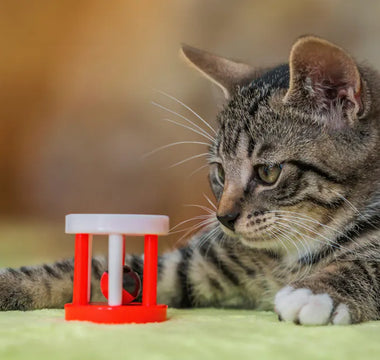
Your indoor cat just knocked something off a shelf. They made full eye contact with you while doing it. That was not an accident.
Cats are predators running on brains that evolved to spend 40–60% of waking hours problem-solving, hunting, and exploring. Your indoor cat has: a food bowl, four familiar walls, and you — when you're home, which isn't all day. The gap between what their brain expects and what the environment provides is genuinely enormous.
According to ASPCA, the majority of behavioral problems in indoor cats trace directly to enrichment deficit rather than personality. The shelf wasn't random. Here's how to address the actual issue.
What "Bored Cat" Actually Looks Like
Some signs are obvious. Most get misread as "just personality."
Obvious:
- 3am zoomies (energy that should have been spent during the day)
- Attacking ankles unprovoked (redirected hunting drive looking for a target)
- Knocking things off surfaces — and making eye contact while doing it
- Excessive meowing at night
Less obvious:
- Over-grooming or bald patches (a stress response, not a medical issue until ruled out)
- Eating too fast, then immediately prowling for more (foraging instinct unsatisfied by bowl feeding)
- Weight gain from inactivity
- Sleeping longer than usual, plus general flatness and disengagement
None of these are quirks. They're behavioral outputs of genuine unmet needs. Good news: almost all of them are reversible.
The Zero-Effort Wins
Start here. These cost nothing or close to it, take minutes to set up, and work passively all day.
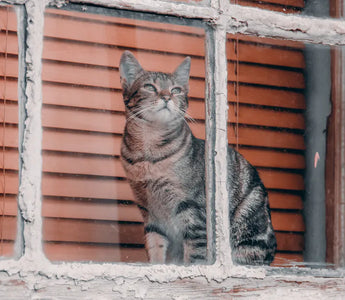
Window access — a clear view outside where outdoor life is visible: birds, squirrels, pedestrians, cars. "Cat TV" runs all day with zero ongoing effort. Place an inexpensive bird feeder outside the favorite window and you've programmed the channel.
Cardboard boxes — a new box is a new investigation. Cut some holes in the sides and it becomes a hunt-and-ambush environment. Free. Consistently more engaging than most commercial toys. Modify or replace weekly when interest drops.
Toy rotation — keep most toys stored and swap out a few every few days. Familiarity kills engagement. A toy that's been visible for three weeks is furniture. A toy that reappears after a break is suddenly prey again.
The 15-Minute Daily Routine
If you commit to one thing: 15 minutes of active wand toy play per day. Morning or evening.

A window with active outdoor life is one of the most powerful passive enrichment tools for indoor cats — and it costs nothing.
If you commit to one thing: 15 minutes of active wand toy play per day. Morning or evening. That's the baseline.
Why it works: The wand toy session — run with the toy moving away from the cat in prey-like patterns — engages the complete hunt sequence: stalk, pursue, pounce, catch. End each session by letting them catch the toy and offering a small treat. This completes the stalk-pounce-catch-eat cycle the brain is wired around. A cat who has completed this cycle is calmer, less likely to redirect energy onto your belongings or feet.
The two-session upgrade: Morning and evening, 10–15 minutes each. Maps onto cats' natural crepuscular activity peaks (most active at dawn and dusk) and covers the behavioral baseline for most indoor cats completely.
Consistency beats duration. Most days of 10 minutes beats occasional 30-minute sessions with weeks of nothing between.
Foraging: The Biggest Missed Opportunity
This is where most indoor cat owners leave the most enrichment value on the table.
This is where most indoor cat owners leave the most enrichment value on the table.
A food bowl solves hunger. It does nothing for the foraging instinct — the behavioral drive behind wild cats spending 40–60% of waking hours actively seeking and working for food. You've replaced a multi-hour foraging session with 30 seconds of eating. The brain registers "full" but not "enriched."
The fix: Replace at least one bowl feeding per day with a puzzle feeder or lick mat. This turns a 30-second meal into a 10–20 minute foraging session. The mental engagement is real. The behavior improvements are consistent.
Critical cat-specific note: Dog puzzle feeders don't work for most cats. The grooves are too deep, and whisker fatigue from pressing into narrow spaces makes them genuinely uncomfortable. Cat-appropriate feeders need shallower profiles and wider access points. The lowest barrier: a flat lick mat spread with wet food. Immediately effective. No friction to adopt.
See our Cat Slow Feeder Guide for cat-specific options and the Pets Sparkle Slow Feeders Collection for shallow-profile designs that actually work.
Passive Environmental Enrichment
These are the set-it-and-forget-it investments that deliver enrichment value every day without ongoing effort: Browse cat enrichment products at the Pets Sparkle Cats Collection.
These are the set-it-and-forget-it investments that deliver enrichment value every day without ongoing effort:
Cat tree at a window — vertical access, climbing, and window view in one piece of furniture. The single highest-impact purchase for most indoor cats. A cat who can climb to observe from height is measurably calmer than one confined to floor level.
Scratch surfaces in multiple locations — one vertical post (tall enough for a full-body back stretch — most commercial posts are too short, which is exactly why cats prefer sofas), one horizontal cardboard scratcher. Scratching is territory marking, stress relief, and stretching. The need doesn't disappear if appropriate surfaces aren't available; it redirects to your furniture.
Catnip or silver vine — roughly 50–60% of cats have the catnip response (it's genetic). Silver vine works for many catnip-immune individuals. Sprinkle periodically on toys or scratch surfaces. Not daily — it loses effect with overuse.
Novel smells — periodically bring in something from outside: fresh herbs, a leaf, an interesting container. Cats experience significant information through scent that humans completely underestimate.
Browse cat enrichment products at the Pets Sparkle Cats Collection.
FAQ
Daily wand play (10–15 min), puzzle feeder replacing one bowl meal, window access with outdoor activity.
Q: How do I mentally stimulate my indoor cat?
Daily wand play (10–15 min), puzzle feeder replacing one bowl meal, window access with outdoor activity. Those three cover core needs in under 20 minutes of active effort per day.
Q: How do I know if my cat is bored?
3am energy, ankle attacks, shelf-clearing with eye contact, over-grooming, eating fast then prowling immediately after. Behavioral outputs of unmet needs — not personality.
Q: What's the most stimulating thing for indoor cats?
Foraging-based feeding. Replacing a bowl with a puzzle feeder or lick mat engages the foraging instinct for 10–20 minutes instead of 30 seconds. Highest single-impact change most cat owners can make.
Q: How much enrichment does an indoor cat need per day?
At minimum: one 15-minute play session, one foraging meal, window access. Ideally: two play sessions, one foraging meal, window view with outdoor life, one novel element. That covers all major behavioral categories.
Q: Do indoor cats get depressed from boredom?
Not in the clinical human sense — but chronic under-stimulation produces behavioral stress responses that look similar. Lethargy, over-grooming, aggression. These resolve with consistent enrichment in most cases.
Key Takeaways
- The single biggest predictor of success is owner consistency — doing the routine daily even on days you don't see immediate change.
- Mental enrichment matters as much as physical exercise. Both together produce results that neither delivers alone.
- For ongoing or severe issues, working with a vet adds tools (medication, behavioral protocols) that home interventions can't match.
- Most owners see meaningful improvement in 6–8 weeks of consistent work.
Related Posts
About the Author
Pets Sparkle Editorial Team — Pet enrichment and care specialists with 5+ years of research, product testing, and content experience. Every guide is reviewed against current veterinary and behavioural science guidelines. | petssparkle.com
Sources: ASPCA — Cat Enrichment · AKC — Cat Health