
Reading time: 12 min | Last updated: June 2026 | Author: Pets Sparkle Team
Table of Contents
- Why Indoor Cats Need Deliberate Enrichment
- Hunting and Prey Drive
- Foraging and Feeding Enrichment
- Climbing and Height
- Scratching
- Sensory and Social Enrichment
- Building an Enriched Home: The 5-Layer System
- FAQ
Your indoor cat is safe, warm, fed twice a day, and — if we're being honest — mildly losing their mind from boredom.
That sounds harsh. But here's the reality: a wild or feral cat spends 40–60% of waking hours hunting. They patrol territory, climb, scratch, stalk, and forage throughout the day. Your indoor cat's equivalent? A food bowl that materializes twice daily and a window with variable bird content.
The result shows up as aggression, destructive scratching, weight gain, anxiety, over-grooming, and behavioral veterinarians shaking their heads. Most of these problems have one root cause: enrichment deficit.
the majority of behavioral issues seen in indoor cats trace back to unmet behavioral needs — not medical problems and not "bad personality."
The good news: it's fixable. And you don't need to turn your apartment into a jungle gym (though a cat tree near the window gets you surprisingly far).
Why Indoor Cats Need Deliberate Enrichment
A wild cat spends their day doing:
- Hunting (or attempting to) — roughly 40–60% of waking hours
- Patrolling and marking territory
- Climbing and observing from height
- Foraging and varied feeding behavior
Your indoor cat's equivalent:
- A bowl that appears twice a day (30 seconds to eat)
- A flat, ground-level environment
- A window, if they're lucky
- You, for a few hours in the evening
The gap is enormous. Enrichment products close it — by giving cats meaningful, species-appropriate ways to express natural behaviors inside a safe home.
Category 1: Hunting and Prey Drive Enrichment
Cats are obligate predators. The stalk-pounce-catch sequence is hardwired. Indoor cats who can't express it redirect it toward your ankles at 3am — which is funny once and progressively less funny every subsequent time.
Products: Feather wands (operated by you — always more effective than any automatic toy), battery-powered automatic toys (robotic mice, spinning feather arms), tunnels for chase-and-ambush play.
The key insight: Move the toy away from the cat to trigger the chase instinct. Moving toward them reads as a threat. Moving away reads as prey. This single adjustment dramatically improves toy engagement for cats who "seem uninterested."
What works best: Daily 10–15 minute interactive wand sessions. Two sessions per day (morning and evening) covers the baseline need. One session of zero doesn't.
Category 2: Foraging and Feeding Enrichment
Replacing bowl feeding with foraging-based enrichment feeding is the single highest-impact change most cat owners can make.
In the wild, cats eat multiple small prey meals spread throughout the day. Two concentrated bowl feedings don't satisfy the foraging drive — they solve hunger but miss everything else.
Products: Puzzle feeders, lick mats, snuffle mats, treat-dispensing balls, scatter feeding across the floor.
The benefit beyond enrichment: Slowed eating pace reduces regurgitation (one of the most common cat owner complaints), reduces obesity by engaging the fullness feedback loop, and provides 10–20 minutes of mental engagement that a bowl simply can't.
For cats specifically, the key is starting simple. A shallow lick mat with wet food spread across it is the lowest barrier to entry. Deep dog puzzle feeders frustrate cats — their tongues are shorter and less powerful. See our detailed Cat Slow Feeder Guide for cat-specific options in the Pets Sparkle Slow Feeders Collection.
Category 3: Climbing and Height Enrichment
Cats feel more secure when they can observe from above. A cat who can reach elevated spaces is measurably calmer and more confident than one confined to floor level — it's not a preference, it's a survival-wired need.
Products: Cat trees, wall-mounted cat shelves, window perches, tall scratching posts with platforms.
The single best enrichment investment: A tall cat tree positioned at a window with interesting outdoor activity visible. This one item addresses climbing, height security, and visual/sensory enrichment simultaneously. For most indoor cats, it's genuinely life-changing.
Category 4: Scratching Enrichment
Scratching is not just nail maintenance — it's territory marking, a stretching exercise, and a stress reliever. Cats who can't scratch appropriately are chronically frustrated, and they'll find something to scratch whether you provide the right surface or not.
Products: Vertical scratching posts (critically: tall enough for a full-body back stretch — most commercial posts are too short), horizontal cardboard scratchers, angled scratchers.
Minimum setup: Two scratch surfaces in different locations — one vertical, one horizontal. More is better.
Category 5: Sensory and Social Enrichment

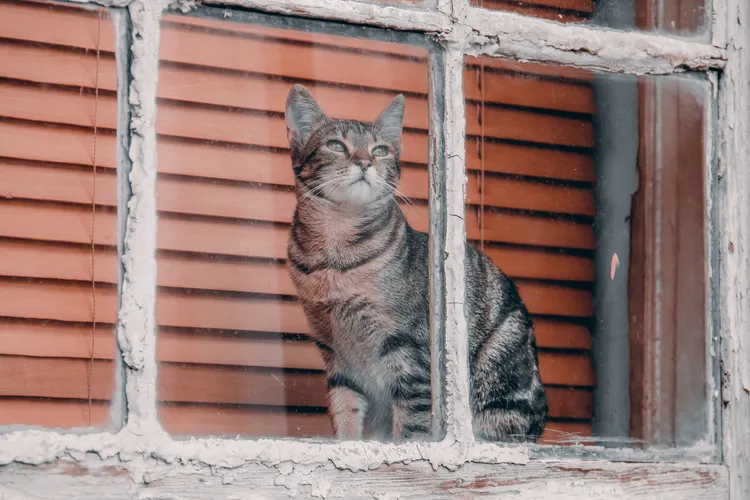
A window with active outdoor life — birds, squirrels, passing pedestrians — is free enrichment that runs all day without any effort from you.
Cats experience the world through smell, sound, and observation in ways most owners significantly underestimate.
Products and approaches:
- Window perches — cat TV." Endless passive stimulation from outdoor sights and sounds "
- Bird feeders outside windows — place an inexpensive feeder outside the favorite window; transforms it into an endlessly engaging entertainment source
- Catnip and silver vine — roughly 50–60% of cats respond to catnip (it's genetic). More cats respond to silver vine — a useful alternative for catnip-immune individuals
- Puzzle boxes — a cardboard box with a few holes cut in it. Genuinely free. Genuinely effective.
- Novel smells — bring in fresh leaves, herbs from the garden, or outdoor objects periodically. Scent novelty is highly stimulating for cats
Building an Enriched Home: The 5-Layer System
You don't need to do everything at once. Build in this order:
- Vertical space — ensure at least one elevated platform is accessible. A cat tree, cleared bookshelf, or window perch works.
- Scratch surfaces — at least two in different locations: one vertical post, one horizontal scratcher
- Daily play — 10–15 minutes with a wand toy, actively, every day. This is the foundation.
- Feeding enrichment — replace at least one bowl feeding with a lick mat or shallow puzzle feeder. This creates 15+ minutes of daily foraging engagement.
- Sensory access — a window with a view and ideally something to watch outside it
A cat living in this environment has dramatically fewer behavioral problems than one in an unenriched home. The five layers together address every major natural behavior category.
Browse cat enrichment products at the Pets Sparkle Cats Collection and the Slow Feeders Collection.
FAQ
Q: Do indoor cats really need enrichment?
Yes — most behavioral problems in indoor cats trace directly to enrichment deficit. Indoor life is safe but not naturally stimulating. Deliberate enrichment closes that gap.
Q: What are the most effective enrichment products?
Cat tree at the window, puzzle feeder replacing one bowl meal daily, wand toy used actively for 10–15 min/day, two scratch surfaces. These four address every major behavioral need.
Q: How do I get my cat interested in toys?
Move the toy away from them, not toward them. Start puzzle feeders with wet food on a flat lick mat. Add catnip to things you want them to investigate.
Q: What is the cheapest way to enrich my indoor cat?
A window with a view, cardboard boxes with cut holes, toy rotation from what you own, and scatter feeding on the floor. Free. Fully effective for core needs.
Q: How long until I see behavioral improvements from enrichment?
Most owners see improvement within 1–2 weeks of consistent enrichment. 3am zoomies and ankle attacks typically reduce within a week of daily play. Consistent enrichment produces consistent results.
Related Posts
- Best Interactive Cat Toys
- Slow Feeders for Cats
- How to Keep an Indoor Cat Mentally Stimulated
- Best Cat Beds
About the Author
Pets Sparkle Editorial Team — Pet enrichment and care specialists with 5+ years of research, product testing, and content experience. Every guide is reviewed against current veterinary and behavioural science guidelines. | petssparkle.com
Sources: ASPCA — Cat Care · AKC — Cat Enrichment