
Reading time: 6 min | Last updated: June 2026 | Author: Pets Sparkle Team
Table of Contents
1. Why Small Dogs Need Slow Feeders Too
2. What to Look for in a Small Dog Slow Feeder
3. Best Types for Small Breeds
4. Slow Feeders for Puppies Specifically
5. Sizing Reference for Small Breeds
6. FAQ
The assumption that slow feeders are only for large dogs is wrong — and costly for small dog owners who discover it the hard way.
Brachycephalic breeds (Pugs, French Bulldogs, English Bulldogs) are among the breeds most improved by slow feeding. Their flattened anatomy causes them to swallow significantly more air per mouthful than any other breed type. Air ingestion is a chronic problem for flat-faced breeds that contributes to digestive discomfort, gas, and respiratory stress.
For Dachshunds, Chihuahuas, and Yorkshire Terriers, fast eating contributes to the obesity and digestive issues these breeds are statistically prone to. The fix is simple — and scales perfectly to their size.
Why Small Dogs Need Slow Feeders Too
- Brachycephalic breeds swallow enormous volumes of air with each gulp — more than any other breed type — due to their anatomy
- Small breeds are more obesity-prone — fast eating bypasses satiety signaling, leading to overeating in breeds where even small caloric excess has significant health impact
- Dachshunds are highly prone to digestive issues made worse by speed eating
- Chihuahuas eat so fast relative to their tiny digestive systems that regurgitation after meals is extremely common without a slow feeder
What to Look for in a Small Dog Slow Feeder
Shallow Grooves
Small dog = short snout = short tongue. Grooves deeper than 1–1.5 inches make food inaccessible. Small dog slow feeders should have shallow, wide ridges reachable by a compact tongue.
Small Capacity (½–2 Cup)
An oversized bowl is confusing and awkward for a small dog. The bowl should feel proportionally correct — similar in footprint to a standard small-dog bowl.
Smooth, Rounded Ridge Edges
Small dogs press their entire face into the bowl. Sharp or rough-edged ridges irritate sensitive snouts. Choose bowls with soft, rounded ridge profiles.
Wide Rim Opening (for Brachycephalic Breeds)
Flat-faced breeds need a wide opening that doesn't require them to bury their nose into the bowl, which worsens breathing restriction.
Best Types for Small Breeds
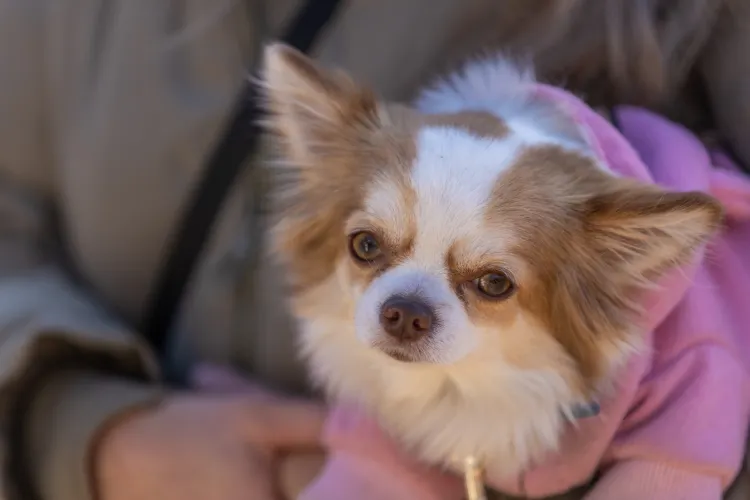
For brachycephalic small breeds, lick mats are often the most comfortable feeding format.
Lick mat — The best starting point for small dogs and brachycephalic breeds. Wet food or toppers spread across a textured silicone surface. Zero groove-depth frustration. Also calming — licking releases endorphins, according to ASPCA behavioral research.
Shallow maze bowl (½–2 cup) — The everyday workhorse. Shallow ridges, small footprint, dishwasher safe. Works for dry and wet food equally.
Beginner puzzle feeder for small dogs — Cat-sized puzzle feeders are ideal for small dog breeds — the mechanisms are appropriately scaled for a compact snout. Browse the Pets Sparkle Slow Feeders Collection for small-dog appropriate options.
Slow Feeders for Puppies Specifically
Puppies under 4 months should use the simplest possible design:
- Lick mat with softened food — lowest barrier to entry, zero frustration
- Very shallow maze bowl — one-level patterns only
- Avoid all complex puzzle mechanisms until 4+ months
Key rules:
- Never force feeding — if a puppy walks away frustrated, simplify the feeder
- Use wet or moistened kibble for the first few sessions
- Monitor closely — ensure the puppy is eating enough, not just giving up
- Keep sessions positive — reward any engagement with the feeder with praise
Sizing Reference for Small Breeds
Quick answer: Browse size-appropriate options in the Pets Sparkle Slow Feeders Collection, and see the Complete Slow Feeder Guide for the full picture on types and techniques.
| Breed | Weight | Meal Size | Recommended Capacity |
|---|---|---|---|
| Chihuahua | 2–6 lbs | ¼–½ cup | ½–1 cup |
| Yorkshire Terrier | 4–7 lbs | ¼–½ cup | ½–1 cup |
| Shih Tzu | 9–16 lbs | ½–¾ cup | 1–1.5 cup |
| Pug | 14–18 lbs | ½–¾ cup | 1–1.5 cup |
| French Bulldog | 20–28 lbs | ¾–1 cup | 1–2 cup |
| Dachshund | 8–32 lbs | ½–1 cup | 1–2 cup |
| Beagle | 20–30 lbs | 1–1.5 cups | 2 cup |
Browse size-appropriate options in the Pets Sparkle Slow Feeders Collection, and see the Complete Slow Feeder Guide for the full picture on types and techniques.
FAQ
Q: Do small dogs need slow feeder bowls?
Yes — especially brachycephalic breeds who swallow the most air per mouthful of any dog type.
Q: What slow feeder is best for a Chihuahua or Pug?
A shallow maze bowl (½–2 cup, grooves under 1 inch deep) or a lick mat for flat-faced breeds.
Q: Can puppies under 12 weeks use a slow feeder?
Yes — use a lick mat with soft food, or the shallowest maze bowl available. Avoid puzzles for very young puppies.
Q: Why does my small dog throw up right after eating?
Almost always a speed-eating problem. A lick mat or shallow slow feeder resolves this within 1–2 weeks of consistent use.
Q: What's the difference between a slow feeder and a lick mat for small dogs?
A slow feeder bowl uses ridges to slow dry kibble eating. A lick mat spreads wet food across a flat textured surface — better for brachycephalic breeds who struggle with deep grooves.
Key Takeaways
- The single biggest predictor of success is owner consistency — doing the routine daily even on days you don't see immediate change.
- Mental enrichment matters as much as physical exercise. Both together produce results that neither delivers alone.
- For ongoing or severe issues, working with a vet adds tools (medication, behavioral protocols) that home interventions can't match.
- Most owners see meaningful improvement in 6–8 weeks of consistent work.
Related Posts
About the Author
Pets Sparkle Editorial Team — Pet enrichment and care specialists with 5+ years of research, product testing, and content experience. Every guide is reviewed against current veterinary and behavioural science guidelines. | petssparkle.com
Sources: ASPCA — Dog Behavior