
Reading time: 6 min | Last updated: June 2026 | Author: Pets Sparkle Team
Table of Contents
1. Before You Start: Choose the Right Difficulty
2. Week-by-Week Introduction Plan
3. How to Handle Frustration
4. Wet Food and Slow Feeders
5. Tips for Puppies
6. Graduating to a Puzzle Feeder
7. FAQ
You've bought the slow feeder. You fill it with kibble. Your dog sniffs it once, looks at you like you've ruined dinner, and walks away.
This is extremely common — and completely solvable. The mistake most owners make is treating the slow feeder like a straightforward bowl swap. It isn't. It's a new concept that requires a positive, gradual introduction.
Before You Start: Choose the Right Difficulty
The most common reason dogs reject slow feeders is starting at the wrong difficulty level. Match the starting point to your dog's enrichment experience: If in doubt, start one level below what you think your dog can handle.
The most common reason dogs reject slow feeders is starting at the wrong difficulty level. Match the starting point to your dog's enrichment experience:
| Experience Level | Starting Point |
|---|---|
| Never used an enrichment feeder | Shallowest, widest maze bowl available (lick mat if very resistant) |
| Used a lick mat before | Shallow maze bowl |
| Used a maze bowl before | Intermediate puzzle feeder |
| Experienced with enrichment feeding | Any difficulty, including puzzle feeder |
If in doubt, start one level below what you think your dog can handle. Browse the Pets Sparkle Slow Feeders Collection for options across every difficulty level.
Week-by-Week Introduction Plan
Week 1: One Meal Per Day
Serve one meal in the slow feeder; keep the second in their regular bowl. On the first two sessions, place a few pieces of high-value food (bits of chicken, freeze-dried treat, or a small smear of peanut butter) in the grooves before adding kibble. This creates an immediate positive first association.
Goal: dog completes the slow feeder meal without significant frustration.
Week 2: Both Meals in the Slow Feeder
If Week 1 went smoothly — they ate the full meal and showed relaxed body language — switch both meals to the slow feeder.
Watch for:
- ✅ Eats fully, moves normally after = continue
- ⚠️ Eats but shows some frustration = see troubleshooting below
- ❌ Doesn't eat or walks away = back to Week 1 for another 3–4 days
Week 3 Onward: Normal Routine
By now most dogs have accepted the slow feeder as their standard bowl. Fill it and serve — no special preparation needed.
How to Handle Frustration
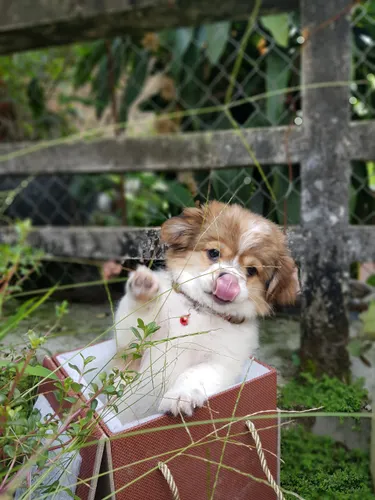
Puppies introduced to enrichment feeding early adapt fastest and most positively.
Dog paws aggressively at the bowl: Difficulty is too high. Try a simpler design with shallower, wider grooves.
Dog stares at you or barks: They want you to "fix" the bowl. Calmly point to the bowl and walk away. If they truly won't engage after 5 minutes, gently guide them with your hand to show how to nose food out.
Dog gives up and walks away: The difficulty is too high. Serve that meal in the regular bowl (don't let them go hungry). Try a simpler design next session.
Dog keeps flipping the bowl over: Get a heavier bowl or one with suction feet. This is a bowl problem, not a behavior problem.
Wet Food and Slow Feeders
Slow feeders work with wet food — the approach is slightly different: - Spread wet food across the surface in a thin layer rather than loading the grooves - A lick mat handles wet food better than a d…
Slow feeders work with wet food — the approach is slightly different:
- Spread wet food across the surface in a thin layer rather than loading the grooves
- A lick mat handles wet food better than a deep maze bowl
- Clean thoroughly after every wet food use — residue in grooves harbors bacteria quickly
Tips for Puppies
Use a lick mat or the shallowest maze bowl for dogs under 4 months - Keep first sessions very short and high-reward — end before frustration - Use softened kibble or puppy wet food for the first week …
- Use a lick mat or the shallowest maze bowl for dogs under 4 months
- Keep first sessions very short and high-reward — end before frustration
- Use softened kibble or puppy wet food for the first week
- Make it exciting: get visibly enthusiastic about the bowl, let the puppy investigate it before food is in it
- Read the Best Slow Feeders for Small Dogs guide for puppy-specific sizing guidance
Graduating to a Puzzle Feeder
Once your dog consistently finishes their slow feeder bowl without frustration — typically 2–4 weeks from introduction — they're ready for a puzzle feeder.
Once your dog consistently finishes their slow feeder bowl without frustration — typically 2–4 weeks from introduction — they're ready for a puzzle feeder.
A puzzle feeder adds genuine cognitive enrichment on top of slowed eating: active problem-solving, brain engagement, and the rewarding satisfaction of working for their meal. The Brainy Puzzle Feeder is designed as the natural next step — interactive enough to challenge, accessible enough that transition is smooth.
FAQ
Q: What if my dog refuses the slow feeder?
Add wet food or broth to the grooves to lower the barrier. If continued refusal, switch to a simpler design or start with a lick mat.
Q: How long until my dog is used to a slow feeder?
Most dogs adapt in 1–3 weeks with a gradual introduction. Starting too hard is the biggest cause of delays.
Q: My dog is frustrated and aggressive — what do I do?
Difficulty level is too high. Switch to a shallower, simpler design immediately and rebuild positive association from scratch.
Q: Can I use a slow feeder with wet food?
Yes — spread thin across the surface, use a lick mat for deep-groove designs, and clean thoroughly after every use.
Q: Should I leave my dog alone with the slow feeder?
Stay in the room for the first 2–3 sessions to watch for frustration. After that, most dogs can eat unsupervised.
Key Takeaways
- The single biggest predictor of success is owner consistency — doing the routine daily even on days you don't see immediate change.
- Mental enrichment matters as much as physical exercise. Both together produce results that neither delivers alone.
- For ongoing or severe issues, working with a vet adds tools (medication, behavioral protocols) that home interventions can't match.
- Most owners see meaningful improvement in 6–8 weeks of consistent work.
Related Posts
About the Author
Pets Sparkle Editorial Team — Pet enrichment and care specialists with 5+ years of research, product testing, and content experience. Every guide is reviewed against current veterinary and behavioural science guidelines. | petssparkle.com
Sources: ASPCA — Dog Care