Reading time: 14 min | Last updated: June 2026 | Author: Pets Sparkle Team
Table of Contents
- What Is a Slow Feeder Bowl?
- Why Do Some Dogs Eat So Fast?
- What Are the Health Risks of Fast Eating?
- What Are the Benefits of a Slow Feeder Bowl?
- What Types of Slow Feeders Exist?
- How Do You Choose a Slow Feeder by Dog Size?
- What's the Difference Between a Slow Feeder and a Puzzle Feeder?
- How Do You Introduce Your Dog to a Slow Feeder?
- What Features Should a Slow Feeder Have?
- How Do You Clean a Slow Feeder?
- Are Slow Feeders Safe for Puppies?
- Frequently Asked Questions
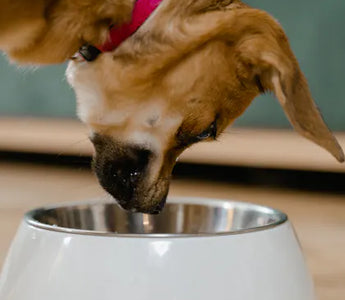
You filled the bowl. You blinked. The bowl is empty. Your dog is staring up at you like they haven't eaten in three days. Sound familiar?
You're not imagining it — and it's more than a quirky habit. Fast eating causes bloating, vomiting, choking, and in large breeds, a life-threatening condition called Gastric Dilatation-Volvulus (GDV) that kills up to 30% of affected dogs even with emergency surgery, according to the American Kennel Club.
The fix is unglamorous and effective. This guide covers everything — what they are, the science of why dogs inhale food, the proven health benefits, the four main types, how to pick the right one for your dog's size, and how to introduce one without your dog staging a hunger strike.
By the end you'll know exactly which slow feeder solves your specific problem, how to use it, and what to avoid. Let's start.
What Is a Slow Feeder Bowl?
A slow feeder bowl is a dog food bowl with built-in obstacles — raised ridges, maze patterns, grooves, or compartments — that physically slow down how fast your dog can reach the food. The result: a meal that used to take 30 seconds now takes 5 to 15 minutes. That's not a small adjustment. That's a complete change in how your dog digests every meal.
The mechanism is simple. A regular bowl puts the entire meal in front of your dog with zero friction. A slow feeder forces them to nudge, lick, and chew their way around obstacles, which means smaller mouthfuls, more chewing, less air swallowed, and a stomach that fills up the way nature intended.
There are two main categories worth knowing:
- Slow feeder bowls — passive design. The obstacles are built into a fixed bowl. Your dog doesn't have to "solve" anything; the food is just harder to scoop up. Works on day one.
- Puzzle feeders — active design. Movable parts, sliders, spinners, or compartments your dog has to manipulate to access food. Adds mental enrichment, but takes 1–2 weeks for most dogs to master.
Both reduce eating speed. Puzzle feeders go further by adding a mental workout to the meal — useful for dogs who finish their day with too much unspent energy. (More on the difference in Section 7.)
Why Do Some Dogs Eat So Fast?
Dogs eat fast because of evolutionary instinct, environmental anxiety, or feeding patterns — and most domesticated dogs have a mix of all three. It's almost never about hunger or food quality. The cause matters because it shapes the fix.
Fast eating is deeply hardwired. Dogs descend from wolves who ate competitively in packs — the fastest eater secured the most calories before a sibling stole them. Even a Yorkie raised in a quiet single-pet home carries that ancient drive. It doesn't disappear because the threat does.
The other contributors stack on top:
- Multi-pet competition anxiety — even without overt fighting, the presence of another animal triggers competitive eating. Dogs in multi-pet homes often inhale meals 30–50% faster than only-pets in identical homes.
- Irregular feeding schedules — uncertainty about when the next meal will come drives urgency. Dogs on inconsistent feeding times eat faster than dogs on a strict twice-a-day routine.
- Calorie-dense food in small portions — fewer pieces means a meal that's already short to begin with. This is especially common for small breeds on premium kibble.
- High mealtime arousal — some dogs redirect every spike of daily excitement into mealtime. Walks, training, and enrichment throughout the day visibly slow their eating speed.
According to PetMD, fast eating is one of the top concerns vets see during routine checkups — yet it's almost entirely preventable with two changes: a slow feeder, and a consistent feeding schedule. The bowl does most of the work.
What Are the Health Risks of Fast Eating?
The four primary health risks of fast eating are choking, bloating, GDV (gastric dilatation-volvulus), poor nutrient absorption, and obesity. For large or deep-chested breeds, GDV is the most serious — it's an emergency condition that's fatal without immediate surgery. Each risk compounds the others over months and years of fast eating.
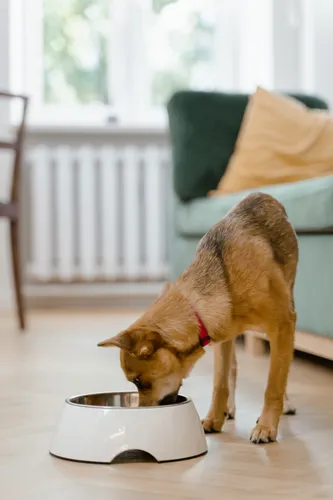
Fast eating is one of the most commonly overlooked dog health risks.
Choking and Regurgitation
Swallowing large, unchewed chunks creates immediate choking risk and frequent regurgitation of undigested food within minutes of eating. If your dog is "throwing up" food that still looks like kibble, that's regurgitation, not vomiting — and it's a direct sign they're eating too fast for their digestive system to keep up. The food never made it past the esophagus before coming back out.
Air Ingestion and Bloating
Fast eating means swallowing big volumes of air with every mouthful. That trapped gas causes visible abdominal distension, post-meal discomfort, and the kind of flatulence that empties a room. Owners often think their dog has a "sensitive stomach" when the actual cause is mechanical: too much air entering with the food.
Gastric Dilatation-Volvulus (GDV) — The Emergency
GDV, commonly called "bloat," is a medical emergency where the gas-filled stomach physically rotates on its axis, cutting off blood supply to the stomach and spleen. Without emergency surgery within hours, it is fatal. The condition disproportionately affects deep-chested breeds — Great Danes, Standard Poodles, German Shepherds, Labradors, Saint Bernards, and Weimaraners — but any dog can develop it. Fast eating is one of the most preventable GDV risk factors.
Poor Nutrient Absorption
Unchewed food places excessive mechanical and enzymatic burden on the digestive system. The result over months: reduced nutrient absorption, loose stools, chronic GI discomfort, and lower energy. The food's there. The body just can't extract from it efficiently.
Obesity and Overconsumption
Eating too fast bypasses satiety signaling. The brain doesn't register "enough" until 15–20 minutes after a meal — but if the meal is over in 30 seconds, the dog still feels hungry, asks for more, and (over time) eats above their actual caloric need. Slowing the meal lets satiety hormones catch up, which means dogs often feel full on slightly smaller portions. Quiet weight management without a diet change.
What Are the Benefits of a Slow Feeder Bowl?
The five primary benefits of a slow feeder bowl are reduced bloat/GDV risk, better digestion, mental stimulation at mealtime, healthier weight management, and reduced food guarding behavior. Most owners notice the digestion and energy improvements within a week.
Reduces Bloat and GDV Risk
Cutting air ingestion per meal dramatically lowers the risk of stomach distension. For large and deep-chested breeds, this is a potentially life-saving daily intervention — the kind of small change with outsized consequences. Veterinary nutritionists routinely recommend slow feeders as the first-line intervention for any dog with a history of bloating.
Aids Digestion
More chewing produces better mechanical breakdown of food, which means easier enzyme action in the stomach, firmer stools, and reduced gas production. Owners often see their dog's "after-meal" demeanor change first — less discomfort, less pacing, less of that hunched-back signal that something's not right. Browse our Slow Feeders Collection for designs across every dog size.
Mental Stimulation at Mealtime
Working through a maze or ridged pattern engages the dog's brain. Dogs who get mental stimulation at mealtime are calmer in the hour after a meal — particularly noticeable for high-drive breeds.
Supports Healthy Weight Management
Extended mealtimes allow satiety hormones to register before the meal ends, meaning dogs often feel full on slightly smaller portions. For dogs trending toward overweight, switching from a regular bowl to a slow feeder can drop weight by 0.5–1 kg over 3 months without changing food or quantity.
Reduces Food Guarding Behavior
Slower, more deliberate eating lowers the hyper-aroused state that contributes to food guarding and resource-related aggression. The dog isn't in "secure-the-resource" mode the entire meal. Multi-pet households with mealtime tension often see noticeable improvement within 2 weeks.
What Types of Slow Feeders Exist?
The four main types of slow feeders are standard slow feeder bowls, lick mats, puzzle feeders, and snuffle mats. Each works for a different combination of dog personality, food type, and goal. Most dogs benefit from owning two: one for everyday meals, one for special enrichment sessions.
Standard Slow Feeder Bowl
Raised ridges, spirals, or maze patterns built into the base of a bowl. Works with dry kibble, wet food, and raw diets. The best entry-level option and what 80% of owners should start with.
Best for: All dogs, first-time enrichment feeders, wet and dry food, easy daily use
Lick Mat
Flat silicone mat with a textured surface. Designed for wet food, purees, peanut butter, yogurt, or spreadable toppers licked slowly across the surface. Lick mats also have a calming effect — repetitive licking releases endorphins, which makes them genuinely useful before stressful events (vet visits, fireworks, baths).
Best for: Anxious dogs, puppies, dental support, brachycephalic breeds, calming before stressful events
Puzzle Feeder / Interactive Feeder
Trays with sliders, spinning compartments, or flip covers that the dog manipulates to access food. Multiple difficulty levels available. The biggest mental enrichment benefit, but requires 1–2 weeks of training to use without frustration.
Best for: High-intelligence breeds, mental enrichment, dogs who've mastered basic slow feeders, owners who want their dog mentally tired
Snuffle Mat
Rubber mat with fabric strips where kibble is hidden in fibers. Dog "forages" by sniffing through the layers — closest to natural foraging behavior. Particularly effective for senior dogs whose teeth aren't up to harder puzzles, and for nervous dogs who calm through sniffing.
Best for: Scent-driven enrichment, anxious dogs, senior dogs, dogs with strong prey drive who need an outlet
How Do You Choose a Slow Feeder by Dog Size?
Match the slow feeder type and bowl capacity to your dog's weight and breed shape. Toy breeds need shallow grooves and small capacity; giant breeds need deep mazes, wide layouts, and ideally an elevated stand. Picking the wrong size is the #1 reason dogs reject a slow feeder.
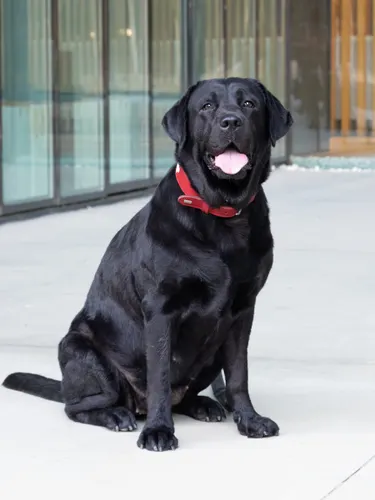
Large and deep-chested breeds like Labradors benefit most from slow feeders.
| Dog Size | Weight | Recommended Type | Min. Bowl Capacity |
|---|---|---|---|
| Toy / Small | Under 20 lbs | Lick mat or shallow maze | 1–2 cup |
| Medium | 20–50 lbs | Standard maze or beginner puzzle | 2–4 cup |
| Large | 50–90 lbs | Deep maze or elevated puzzle feeder | 4–6 cup |
| Giant | 90+ lbs | Wide maze, elevated stand recommended | 6+ cup |
Important note for giant breeds: Elevation — positioning the bowl at chest height — combined with a slow feeder provides added protection against GDV in breeds like Great Danes and Saint Bernards. The dog isn't bending down sharply to eat, which reduces the spinal and stomach mechanics that contribute to bloat.
Important note for brachycephalic breeds (Frenchies, Pugs, Bulldogs): Lick mats and very shallow maze bowls are usually more comfortable than standard slow feeders, which can be hard for short-faced dogs to reach into.
What's the Difference Between a Slow Feeder and a Puzzle Feeder?
A slow feeder uses passive obstacles to slow eating. A puzzle feeder requires active problem-solving to access food. Slow feeders work day one; puzzle feeders need 1–2 weeks of training but provide stronger mental enrichment. Most dogs benefit from owning both — slow feeder for everyday meals, puzzle feeder for enrichment sessions or rainy-day mental workouts.
| Feature | Slow Feeder Bowl | Puzzle Feeder |
|---|---|---|
| How it works | Passive — obstacles get in the way | Active — dog must solve to access food |
| Learning curve | None — works day one | 1–2 weeks to master |
| Mental enrichment | Low–Medium | High |
| Best for | All dogs, beginners | Smart breeds, post-slow-feeder graduation |
| Cleaning | Easy | More effort (more parts) |
For most dogs: start with a slow feeder bowl, graduate to a puzzle feeder once they're comfortable. The transition is the key — drop a puzzle feeder in front of a fast-eating dog who's never had any mealtime resistance and you'll watch them give up in 30 seconds. Build the habit first, add complexity second. Browse the Pets Sparkle Slow Feeders Collection for both types.
How Do You Introduce Your Dog to a Slow Feeder?
Introduce a slow feeder gradually over 2–3 weeks: one meal a day in week 1, both meals in week 2, normal routine in week 3. If your dog gets frustrated, lower the difficulty by adding wet food or broth to the grooves. Most dogs adapt within the first 5 meals. The few that struggle usually do so because the bowl is too advanced for their experience level.
Week 1: One meal per day in the slow feeder; second meal in regular bowl. Low pressure, positive introduction. Most dogs will sniff, hesitate, then start nudging at the food within a minute.
Week 2: Both meals in the slow feeder. Watch for frustration signals (aggressive pawing, abandoning the bowl, walking away with food still in it). If you see them, drop back to once a day for another week before retrying.
Week 3: Normal routine. If frustration occurred in Week 2, spread a thin layer of wet food or broth across the grooves to lower the initial difficulty. The wet layer disappears first — by the time your dog reaches the dry food underneath, they've already settled into the slow eating rhythm.
Pro tip: Never force a frustrated dog to keep eating from a slow feeder. Mealtime stress is counterproductive to the entire goal — calm digestion. If three sessions in a row look stressful, sized down to a less aggressive design or switch to a lick mat first to build comfort. See our full step-by-step guide: How to Introduce Your Dog to a Slow Feeder.
What Features Should a Slow Feeder Have?
The five non-negotiable features of a quality slow feeder are: a non-slip base, dishwasher-safe construction, BPA-free food-grade materials, appropriate groove depth for your dog's size, and stable heavy build that won't flip. Cheap slow feeders often miss two or three of these — and the result is a bowl your dog pushes around the kitchen instead of eating from.
- Non-slip base — prevents the bowl sliding across the floor while your dog noses at it. Especially critical for enthusiastic eaters who'd otherwise chase the bowl into a corner.
- Dishwasher safe — essential hygiene. A slow feeder collects food residue in deep grooves; if it can't go in the dishwasher, you'll skip cleanings, and bacteria will accumulate.
- BPA-free, food-grade materials — polypropylene, ABS plastic, or food-grade silicone. Avoid bowls without explicit material disclosure; cheap unbranded slow feeders sometimes use industrial plastics.
- Appropriate groove depth for breed size — too shallow makes the bowl pointless (your dog finishes in 90 seconds); too deep frustrates them and they walk away. Match to your dog's size per the table above.
- Stable, heavy construction — large dogs will flip lightweight slow feeders. Look for weighted or wide-base designs.
How Do You Clean a Slow Feeder?
Most slow feeders are top-rack dishwasher safe. For deep grooves, use a bottle brush to remove stuck kibble. Always rinse wet food residue immediately after meals to prevent bacterial buildup. Clean a slow feeder more often than a regular bowl — daily for wet food, every 2–3 days for kibble.
The grooves and ridges that make slow feeders work are also the parts that trap residue. A daily rinse with hot water removes most kibble dust. Once or twice a week, run the bowl through the dishwasher (top rack only — high heat from the bottom can warp silicone).
For lick mats, a quick rinse plus weekly dishwasher cycle is enough. Snuffle mats need hand-washing and air drying; the fabric can't take dishwasher heat.
If you're using a slow feeder for raw or wet food, increase frequency: rinse immediately after every meal, wash with soap daily, and dishwash twice a week minimum. Salmonella and E. coli love textured surfaces with food residue.
Are Slow Feeders Safe for Puppies?
Yes — slow feeders are safe for puppies as long as you choose a beginner-friendly design with shallow grooves and no movable parts. Most puppies can use a basic slow feeder bowl from 8 weeks. Hold off on complex puzzle feeders until 4 months minimum. Slow feeders actually benefit puppies more than adult dogs because they prevent the lifelong habit of inhaling food from forming in the first place.
The reason puppies need beginner designs: developing teeth and jaws can't navigate aggressive maze patterns yet, and the frustration of failing at a puzzle they're too young for can create a negative mealtime association that's hard to undo later. A simple shallow slow feeder eliminates both problems.
Look for puppy-appropriate slow feeders that have:
- Wide grooves (puppies have less precise nose control)
- Shallow depth (under 2 cm)
- A small footprint (matched to a puppy's mouth size)
- No removable or chewable parts
For very small breed puppies, lick mats are often more practical than maze bowls — they accommodate smaller mouths and add a calming behavior on top of the feeding pace.
Frequently Asked Questions
Q: Do slow feeder bowls actually work?
Yes. Studies show slow feeders reduce eating speed by up to 10x, cutting air ingestion and meaningfully lowering bloat and GDV risk. The science is clear and the effect is reproducible across breeds.
Q: Are slow feeders safe for puppies?
Yes — choose a shallow, simple maze design with wide grooves. Avoid complex puzzles for dogs under 12 weeks. Slow feeders actually benefit puppies more than older dogs because they prevent the inhaling habit from forming.
Q: Can slow feeders prevent bloat 100%?
No method guarantees 100% prevention of GDV. But slow feeding reduces one of its primary preventable triggers and is recommended by veterinary professionals as a core part of bloat-prevention protocol — especially for large and deep-chested breeds.
Q: What's the difference between a slow feeder and a puzzle feeder?
Slow feeders passively reduce eating speed using built-in obstacles. Puzzle feeders require active problem-solving (sliding, spinning, lifting) to access food, adding mental enrichment on top of slowed eating.
Q: How do I clean a slow feeder?
Most are top-rack dishwasher safe. For deep grooves, use a bottle brush. Always rinse wet food residue immediately. Clean daily if using wet/raw food, every 2–3 days for kibble.
Q: Can I use a slow feeder for wet food?
Yes. Lick mats work especially well with wet food. Maze bowls work with wet food if rinsed promptly after use. Avoid very deep grooves for wet food — they're harder to clean thoroughly.
Q: How long should it take a dog to eat from a slow feeder?
A healthy mealtime with a slow feeder takes between 5 and 15 minutes — roughly 10x slower than a regular bowl. If your dog finishes in under 3 minutes, the feeder is too easy and you should size up the difficulty.
Q: Can a dog use a slow feeder every day?
Yes — slow feeders are designed for daily use. There's no fatigue effect; consistent use compounds the digestive and behavioral benefits over weeks and months.
Q: My dog gets frustrated and walks away from the slow feeder. What do I do?
The bowl is too advanced for their current skill. Drop back to an easier design (or a lick mat), spread wet food on the grooves to make initial access easier, and rebuild positive association before increasing difficulty.
Ready to upgrade your dog's mealtime? Browse the Pets Sparkle Slow Feeders Collection.
Related Posts
- Slow Feeder vs Puzzle Feeder: Which Is Right for Your Dog?
- 5 Signs Your Dog Eats Too Fast
- Do Slow Feeders Really Prevent Bloat?
- Best Slow Feeders for Large Dogs
- How to Introduce a Slow Feeder
About the Author
Pets Sparkle Editorial Team — Pet enrichment and care specialists with 5+ years of research, product testing, and content experience. Every guide is reviewed against current veterinary and behavioural science guidelines before publication. | petssparkle.com
Sources: AKC — Bloat in Dogs · PetMD — Fast Eating