Reading time: 7 min | Last updated: June 2026 | Author: Pets Sparkle Team
Table of Contents
1. Why Mental Stimulation Matters as Much as Exercise
2. How Much Your Dog Needs: By Breed & Energy Level
3. By Age: Puppies, Adults, and Seniors
4. What Counts as Mental Stimulation (Hierarchy)
5. Easy Ways to Add Enrichment Without Extra Time
6. Signs Your Dog Isn't Getting Enough
7. FAQ
Most dog owners ask "did my dog get enough exercise today?" but very few ask "did my dog get enough mental exercise today?"
These are equally important questions — and for many dogs, the mental side is the more neglected one. A physically tired but cognitively under-stimulated dog is still an anxious, destructive, difficult-to-settle dog.
Why Mental Stimulation Matters as Much as Exercise
Dogs evolved as working animals. Herding, hunting, tracking, guarding — every breed's ancestors had a job requiring sustained mental engagement throughout the day. Today's pet dogs live in comparatively sterile environments where food appears in a bowl, no foraging is required, and the biggest daily challenge is waiting for a walk.
This mismatch between what the brain evolved to do and what it actually does creates a "cognitive deficit" that manifests as:
- Destructive behavior (chewing, digging, shredding)
- Excessive barking and vocalization
- Anxiety and hypervigilance
- Compulsive repetitive behaviors (tail chasing, paw licking, spinning)
- Difficulty settling, resting, or relaxing
As the AKC notes, mental stimulation is not optional enrichment for working breeds — it's a biological need. Providing it consistently resolves many of the behavioral issues owners attribute to "stubbornness" or "temperament."
Mental stimulation doesn't replace physical exercise. It complements it. For many dogs, 20 minutes of puzzle-solving is genuinely as tiring as a 45-minute walk.
How Much Your Dog Needs: By Breed & Energy Level

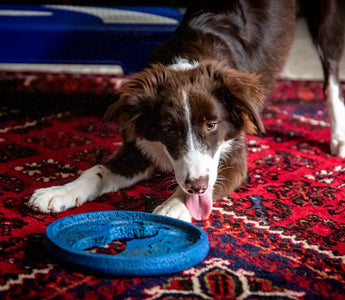
Border Collie puppies especially need structured daily mental engagement to prevent anxiety and destructive behavior from developing.
| Breed Category | Examples | Min. Daily Mental Stimulation |
|---|---|---|
| High-drive working breeds | Border Collie, Malinois, Cattle Dog, Husky | 60–90 min |
| Active sporting breeds | Labrador, Golden Retriever, Vizsla, Spaniel | 45–60 min |
| Scent hounds | Beagle, Bloodhound, Basset Hound | 45–60 min (scent-focused) |
| Terriers | Jack Russell, Scottish, Wire Fox | 30–45 min |
| Companion breeds | Shih Tzu, Cavalier, Bichon | 20–30 min |
| Giant breeds | Great Dane, Newfoundland, Saint Bernard | 20–30 min (lower intensity) |
Note: These are minimums for a behaviorally healthy dog. A dog already showing behavioral problems needs significantly more — and an enrichment-based approach rather than discipline-based intervention.
By Age: Puppies, Adults, and Seniors
Puppies (Under 1 Year)
Mental stimulation is critical for brain development, but sessions must be short — 3–5 minutes maximum — spread throughout the day. The developing brain overstimulates quickly. Five short sessions beats one long session. Puzzle feeders, basic training, and novel object exploration are all ideal.
Adult Dogs (1–7 Years)
Full daily allotment per breed guidelines. This is the peak period for enrichment need — and the period when neglect has the most behavioral consequences.
Senior Dogs (7+ Years)
Mental stimulation remains critical and may help delay cognitive decline. Research cited by PetMD suggests consistent cognitive engagement in senior dogs parallels the brain-health benefits seen in aging humans who engage in daily mental challenges. Reduce intensity and duration if fatigue is visible, but never eliminate enrichment entirely.
What Counts as Mental Stimulation (Hierarchy)
Not all mental engagement is equal. Here's a hierarchy from most to least cognitively demanding:
High demand (aim for at least one daily):
- Puzzle feeders and interactive feeders — sustained problem-solving cycles
- Formal training sessions — requires focused attention and impulse control
- Scent work and nose games — engages the olfactory brain most deeply
- Novel environments with new smells, sights, and textures
Medium demand (great for filling the day):
- Snuffle mats and scatter feeding — foraging behavior
- Long chew sessions — jaw work plus sustained focus
- Interactive toy play with the owner
Low demand (fine supplements, not primary enrichment):
- Watching out the window
- Regular walks on familiar routes
- Background TV or ambient music
A balanced daily routine includes at least one high-demand activity, supported by two or three medium-demand activities throughout the day.
Easy Ways to Add Enrichment Without Extra Time
The most common objection: "I don't have time." But many enrichment activities replace existing routines rather than adding new ones.
Replace the food bowl permanently. The single highest-impact, zero-extra-time enrichment change you can make. Using the Brainy Puzzle Feeder at every meal automatically adds 15–20 minutes of problem-solving twice a day — without changing your routine at all.
Scatter feed instead of bowl-feeding. Hiding kibble in the grass, across a snuffle mat, or across the floor turns a 30-second meal into 10–15 minutes of nose-led foraging.
Vary the walk route. Sniff walks — where the dog sets the pace and is free to investigate whatever they want — are significantly more mentally tiring than structured heel walks.
5-minute training sessions. Teaching a new trick or reinforcing commands requires focused attention. Five minutes of training is surprisingly fatiguing — and builds the human-dog bond simultaneously.
Browse the Pets Sparkle Dog Toys Collection for enrichment tools that fit into everyday routines.
Signs Your Dog Isn't Getting Enough Mental Stimulation
Quick answer: Restlessness and inability to settle at home after exercise - Destructive behavior without clear anxiety trigger (chewing, digging) - Excessive, attention-seeking barking throughout the day - Hyperactivity on walks — pulling, lunging, reacting to everything - Anxiety symptoms that persist even after adequate physical exercise If you're seeing these signs, the fix is enrichment — not more discipline.
- Restlessness and inability to settle at home after exercise
- Destructive behavior without clear anxiety trigger (chewing, digging)
- Excessive, attention-seeking barking throughout the day
- Hyperactivity on walks — pulling, lunging, reacting to everything
- Anxiety symptoms that persist even after adequate physical exercise
If you're seeing these signs, the fix is enrichment — not more discipline. The Complete Dog Anxiety Guide covers the full approach.
FAQ
Q: How much mental stimulation does a dog need per day?
High-drive working breeds: 60–90 min. Sporting breeds: 45–60 min. Companion/low-energy breeds: 20–30 min. Dogs showing behavioral problems need more.
Q: Is mental stimulation as important as physical exercise?
Yes — and for many breeds, it's more neglected. A physically tired but mentally under-stimulated dog is still anxious and destructive.
Q: What's the easiest way to mentally stimulate a dog?
Replace the food bowl with a puzzle feeder. Two meals daily through a puzzle feeder = 30–40 minutes of cognitive engagement for zero extra time.
Q: What are the signs my dog isn't getting enough?
Restlessness after exercise, destructive chewing, excessive barking, hyperactivity on walks, and anxiety that persists even with adequate physical exercise.
Q: How do I mentally stimulate a senior dog?
Same tools (puzzle feeders, snuffle mats, short training sessions) but shorter, lower-intensity sessions. Never eliminate enrichment entirely — cognitive engagement may help delay age-related cognitive decline.
Key Takeaways
- The single biggest predictor of success is owner consistency — doing the routine daily even on days you don't see immediate change.
- Mental enrichment matters as much as physical exercise. Both together produce results that neither delivers alone.
- For ongoing or severe issues, working with a vet adds tools (medication, behavioral protocols) that home interventions can't match.
- Most owners see meaningful improvement in 6–8 weeks of consistent work.
Related Posts
- Complete Dog Anxiety Guide
- Best Interactive Toys for Anxiety Relief
- Daily Enrichment Schedule for Dogs
- Enrichment Toys vs Puzzle Feeders
About the Author
Pets Sparkle Editorial Team — Pet enrichment and care specialists with 5+ years of research, product testing, and content experience. Every guide is reviewed against current veterinary and behavioural science guidelines. | petssparkle.com
Sources: AKC — Mental Stimulation for Dogs · PetMD — Canine Cognitive Dysfunction